
www.aero-defence.tech
05
'26
Written on Modified on
Strategic Reentry Vehicle Flight Test Validates Hypersonic Aerothermal Architecture
Lockheed Martin advances the Mk21A reentry vehicle program toward Critical Design Review to resolve land-based strategic deterrent survivability challenges.
www.lockheedmartin.com
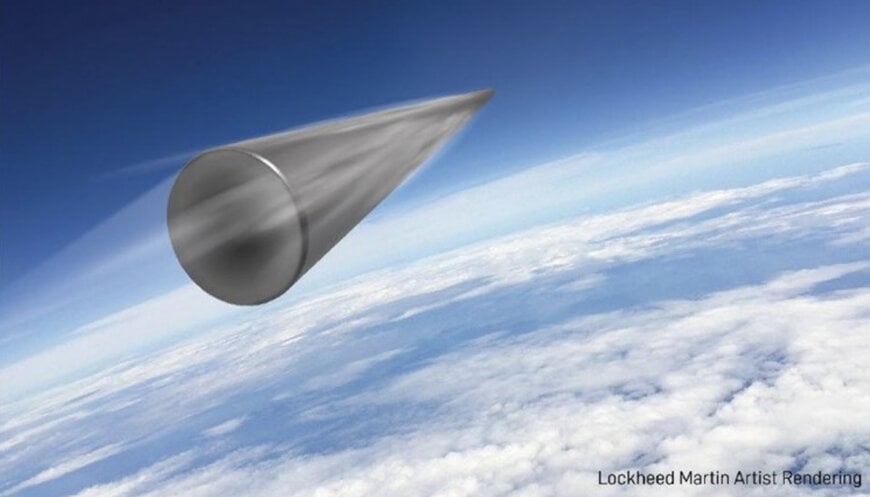
Maintaining the operational viability of ground-based strategic deterrence requires flight hardware capable of surviving severe atmospheric deceleration, extreme aerothermal heating, and hostile defensive interception environments. To address these operational requirements, Lockheed Martin and the United States Air Force completed a developmental flight test of the unarmed Mk21A reentry vehicle, launched over the Pacific Ocean from Vandenberg Space Force Base in California. Developed under a prime defense contract valued at more than one billion dollars, the Mk21A serves as the front-end payload designed to upgrade and replace the legacy Mk21 vehicle aboard future intercontinental ballistic missile architectures, modernizing the ground-based leg of the strategic nuclear triad.
Digital Engineering Workflows in Aerothermal Structural Design
Atmospheric reentry vehicles encounter hypervelocity boundary layers with skin friction generating severe aerodynamic drag and plasma sheath envelopes. Reentry flight systems must preserve internal payload structural integrity and functional electronic architecture across extreme heat flux, vibration spectrums, and deceleration forces without aerodynamic ablation degrading target trajectory.
To overcome these technical obstacles without relying exclusively on physical prototypes, the development program implements digital engineering frameworks. High-fidelity modeling and computer simulations are combined with real flight telemetry to establish digital twins of the vehicle assembly. This computational architecture allows engineers to predict internal mechanical stress, composite shield erosion, and electrical stability across various atmospheric densities, compressing validation schedules and reducing design risk prior to hardware fabrication.
According to Jason Watson, vice president of Strategic Reentry Programs at Lockheed Martin, testing functions as the primary driver of maturity and operational reliability within modernized defense programs. Watson stated that by building on flight telemetry harvested from prior trials, engineering teams directly incorporate practical physical performance into program execution, ensuring the reentry vehicle satisfies strict military performance requirements.
Progress Toward System-Level Critical Design Review
Data harvested from the Pacific Ocean trajectory validates the vehicle’s primary structure, thermal protection barriers, and electrical distribution routing. Telemetry gathered during reentry will inform mechanical refinements, tolerance verifications, and component layouts as the program advances toward its system-level Critical Design Review. Achieving this milestone establishes the finalized engineering baseline necessary to move from developmental prototyping into serial manufacturing pipelines.
Additional Context:
This section details technical specifications and competitive benchmarking not included in the original product announcement.
The Mk21A reentry vehicle program is engineered to integrate specifically with the LGM-35A Sentinel weapon system, the future intercontinental ballistic missile designed to replace the legacy Boeing LGM-30G Minuteman III deployed since 1970. Under Air Force modernization roadmaps, the vehicle is designated to house the W87-1 nuclear warhead, an upgraded warhead modification developed by Lawrence Livermore National Laboratory and the National Nuclear Security Administration to succeed the 1980s-era W78 and legacy W87-0 assemblies. The W87-1 modification modernizes internal safety and arming systems, eliminating legacy hazardous materials while improving detonation margins without requiring underground nuclear yield testing.
From an engineering perspective, modern strategic reentry vehicles differ substantially from maneuverable boost-glide systems. While boost-glide weapons execute non-ballistic atmospheric lift maneuvers across long glide paths, ballistic reentry vehicles follow suborbital parabolic trajectories, reentering the atmosphere at terminal velocities exceeding Mach 20. The primary design challenge for ballistic reentry lies in balancing a low ballistic coefficient for minimal flight time with advanced ablation materials, ensuring extreme target accuracy, structural stability, and resistance against modern ballistic missile defense interceptors.
The successful flight test reflects a critical phase in sustaining the United States nuclear triad alongside the Trident II D5 life-extended submarine-launched ballistic missile and the developing B-21 Raider strategic bomber. Completing early developmental flight demonstrations on dedicated suborbital booster configurations isolates front-end payload performance from booster propulsion testing, verifying aerodynamic and thermal survivability before full missile-stage flight integration commences.
Edited by Natania Lyngdoh, Induportals editor, with AI assistance.
www.lockheedmartin.com
