
www.aero-defence.tech
09
'26
Written on Modified on
Lidar Integration for Airborne Situational Awareness Infrastructure
MicroVision and LAKE FUSION Technologies are collaborating to implement long-range detection platforms for civil and military helicopter operations.
microvision.com
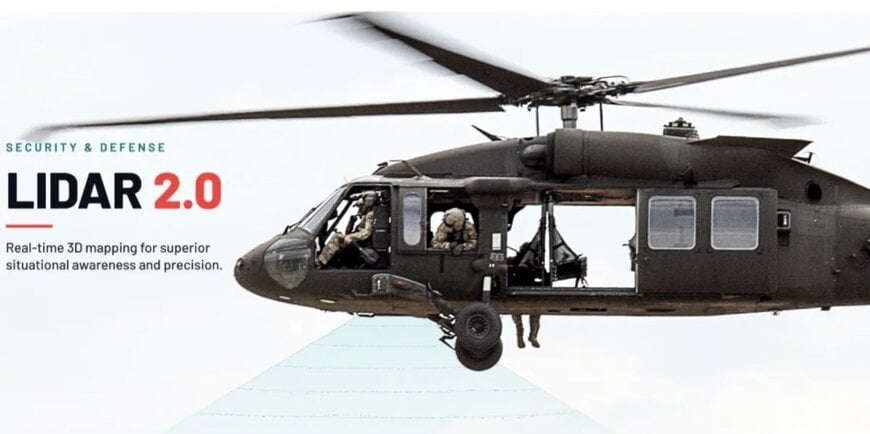
MicroVision and LAKE FUSION Technologies have established a multi-year partnership to integrate long-range lidar sensors into advanced sensor fusion platforms for aviation. The collaboration targets obstacle detection and safety enhancements during low-altitude maneuvers.
Aviation Applications and Operational Context
The technology addresses the operational challenge of detecting difficult-to-see environmental hazards during low-altitude helicopter flights. Concrete use cases include confined-area landings, search and rescue missions, hoisting operations, and off-airport takeoffs. By deploying this system, flight crews gain early warning capabilities against obstacles such as power lines and thin wires, thereby increasing process stability and flight safety in complex environments.
System Architecture and Component Responsibilities
The cooperation combines hardware manufacturing with software engineering to handle the complexity of airborne sensor fusion. MicroVision supplies the long-range lidar sensors, which utilize a 1550-nanometer Class 1 eye-safe laser and an ultra-sensitive indium gallium arsenide (InGaAs) receiver. This hardware configuration enables the detection of small, dark, and low-reflectance objects. LAKE FUSION Technologies integrates two of these sensors into the nose of a helicopter and applies its proprietary software to process the spatial data. The system operates invisibly, ensuring compatibility with night vision goggles for continuous day and night functionality.
Testing, Certification, and Deployment Phases
The partnership transitions the technology from initial testing and validation into a commercial deployment framework extending through 2028. The implementation involves a full product lifecycle approach, including system architecture design, prototyping, aviation certification, and long-term fleet support. LAKE FUSION Technologies leads the integration of the hardware into its AS-1 Awareness Systems, managing the regulatory certification required for airborne deployment.
Strategic Rationale and Operational Impact
The integration of lidar into airborne systems reduces the risk of wire strikes and collisions by establishing a measurable, extended detection range compared to visual operation alone. "This strategic partnership gives us a framework to advance the solution from system development and certification through market introduction and long-term fleet support," stated Christian Meyer, Chief Executive Officer of LAKE FUSION Technologies. Beyond initial aviation deployments, the companies plan to utilize the established architecture for ground-based defense and industrial security applications.
Edited by Aishwarya Mambet, Induportals Editor, with AI assistance.
www.microvision.com
