
www.aero-defence.tech
09
'26
Written on Modified on
ArianeGroup Prometheus Rocket Engine Completes Successful Multi Ignition Testing Campaign
German Aerospace Center (DLR) validated repeated engine firings on the upgraded P5 test stand, demonstrating crucial capabilities for future European reusable liquid methane propulsion systems.
www.dlr.de
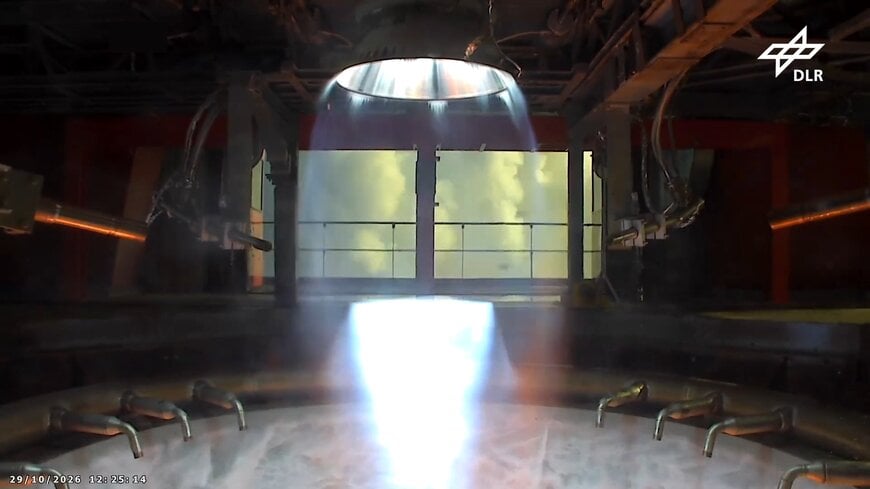
Deutsches Zentrum für Luft- und Raumfahrt (DLR) and ArianeGroup have completed hot-fire trials of the Prometheus rocket engine on the modernized P5 test stand in Lampoldshausen, Germany. The industrial collaboration qualifies liquid methane propulsion sequences for reusable space launch architectures developed under the European Space Agency (ESA) Future Launchers Preparatory Programme.
Industrial Roles and Operational Challenges
Developing reusable rocket propulsion systems requires engines capable of executing multiple restarts during flight profiles, including boost phases, trajectory corrections, and powered vertical landings. ArianeGroup serves as the prime contractor for the 100-tonne-thrust-class Prometheus engine, while DLR operates the P5 facility, which forms part of the ESA testing infrastructure.
The primary engineering challenge lies in validating consecutive engine starts and rapid throttle transitions within a single operational window. Achieving this required coordinating ArianeGroup engine subsystems with ground support infrastructure capable of managing cryogenic liquid methane and liquid oxygen propellants.
Test Infrastructure Modernization
The P5 test facility underwent engineering modifications to support cryogenic methane feed lines, elevated supply pressures, and rapid ground cycle turnaround. During multi-run test sequences, ground infrastructure purges feed channels, vents residual propellants, and stabilizes cryogenic supply lines between successive firings. Sensor arrays monitor critical parameters across the test article, recording chamber pressure, structural temperatures, propellant mass flow rates, and dynamic thrust vectors.
"Up to five ignitions in a single test day place high demands on the coordination of the test stand systems. The fact that we can carry out these procedures automatically, safely and in a reproducible manner is an important step towards testing reusable propulsion systems," stated Frank, addressing the facility coordination requirements.
Cryogenic Propellant Architecture
The Prometheus engine utilizes liquid methane (LCH4) and liquid oxygen (LOX) rather than conventional liquid hydrogen. Liquid methane exhibits higher volumetric density and requires higher boiling points than hydrogen, which reduces thermal insulation overhead, lowers storage volume requirements, and simplifies ground infrastructure.
Variable throttle control remains essential for reusable booster stages. The modernized test stand allows engineers to evaluate combustion stability during dynamic transitions between high-thrust launch configurations and low-thrust throttling settings needed for stage recovery maneuvers.
Technical Impact on Launcher Programs
The hot-fire campaign demonstrated repeated ignitions within a single testing day, validating transient restart procedures without operational disassembly. Data gathered from these runs confirms structural resilience against thermal stress and pressure fluctuations during cyclic engine operation. The operational parameters verified during the Lampoldshausen trials directly inform ongoing development and flight qualification pathways for next-generation European launch vehicles.
Edited by Evgeny Churilov, Induportals Media - Adapted by AI.
www.dlr.de
