
www.aero-defence.tech
13
'26
Written on Modified on
Mission Systems Integration for Unmanned High-Mach Aircraft
Hermeus and Northrop Grumman team up to integrate open-architecture mission systems into reusable unmanned high-Mach aircraft.
www.hermeus.com
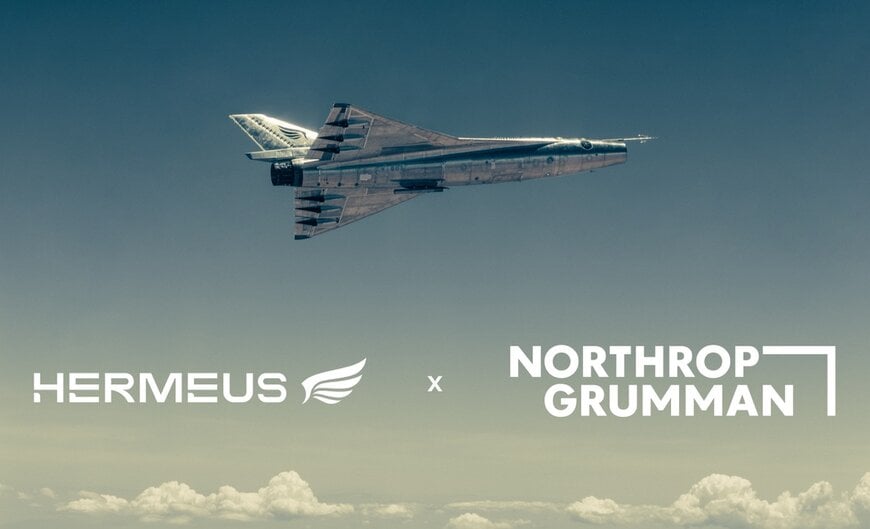
Hermeus and Northrop Grumman have entered into a strategic teaming agreement to equip Hermeus' reusable, unmanned high-Mach aircraft with integrated mission systems for sensing, communications, navigation, and command and control. The cooperation targets defence applications for the U.S. military that require high-speed airframes combined with mature mission technology.
Partners and Responsibilities
Hermeus, based in Hawthorne, California, develops reusable unmanned high-Mach platforms using a rapid prototyping approach that prioritises frequent hardware iteration. Northrop Grumman contributes experience in mission systems and large defence programmes. Under the agreement, Northrop Grumman will provide mission systems design, development, integration and sustainment for Hermeus' next-generation aircraft, while Hermeus supplies the airframe, its rapid development process and its in-house mission management system.
The Engineering Challenge
A high-speed airframe alone does not create operational capability. To perform complex missions, an aircraft must sense its environment, communicate, navigate and accept command and control inputs. Developing and certifying these systems from scratch typically takes years, which conflicts with the goal of fielding new aircraft quickly. Combining a rapidly developed airframe with established mission systems from an experienced integrator is intended to close this gap.
Open Mission Management System Architecture
At the core of the cooperation is Hermeus' mission management system (MMS) core, an open, modular system of systems that keeps flight-critical and mission-critical functions cleanly separated. This separation allows mission capabilities to be added or modified without affecting the functions that keep the aircraft flying. The MMS core is built to U.S. Government reference architectures and standards, including the Agile Mission Suite and Autonomy Government Reference Architectures (AMS-GRA and A-GRA) and the Open Mission Systems/Universal Command and Control Interface (OMS/UCI) standards. By using common, government-defined interfaces, the architecture enables third-party mission components to be integrated in a standardised way. According to the companies, this allows mission capabilities to be integrated and updated in weeks rather than years as requirements evolve.
Integration Approach
Northrop Grumman's mission technology will be integrated onto Hermeus' unmanned aircraft through the open MMS core. Because flight-critical software is isolated, mission payloads and functions can be iterated in parallel with airframe development. The companies aim to shorten the path from an emerging operational need to tested, fieldable capability.
Zach Shore, CEO of Hermeus, said: "Adding Northrop Grumman's battle-tested mission systems will push what those aircraft can do in real world scenarios and help us field operational capability faster."
Applications and Expected Impact
The aircraft are designed to provide speed, range and flexibility while integrating into existing military force structures. Mission systems spanning sensing, communications, navigation and command and control are expected to allow the platforms to operate more autonomously and take on more complex missions. The partners plan to pursue advanced development programmes that require both new airframe technology and proven mission systems. The modular architecture is also intended to support upgrades over the service life of the aircraft, reducing the effort needed to adapt to changing mission requirements.
Edited by Natania Lyngdoh, Induportals editor, with AI assistance.
www.hermeus.com
