
www.aero-defence.tech
13
'26
Written on Modified on
Kratos Launches Portable KnownSpace Recon+ Terminal for Space Domain Awareness
New deployable satellite terminal integrates multi-mission radio frequency monitoring capabilities into a single portable unit, enabling warfighters to detect and classify signals anywhere.
www.kratosdefense.com
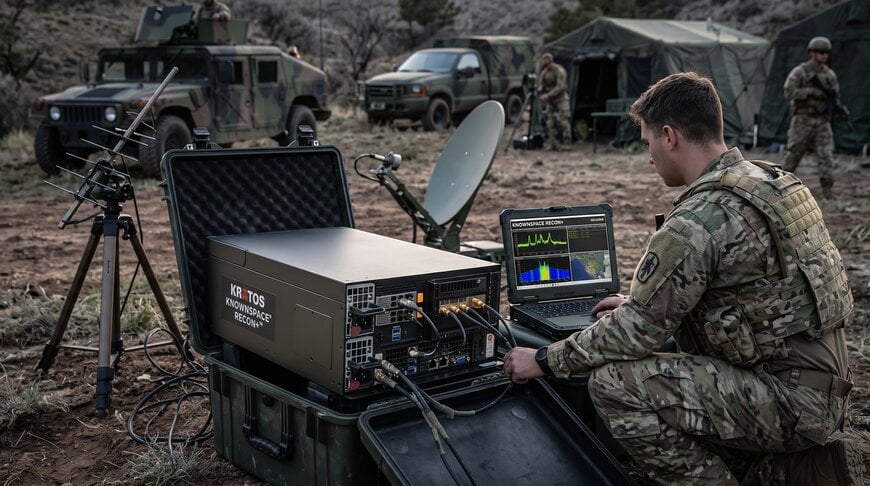
Modern orbital operations and defense missions increasingly depend on continuous Space Domain Awareness (SDA) to track satellite activity, detect signal interference, and identify potential electronic threats. Historically, SDA relied heavily on ground-based optical telescopes and high-power radar installations. While effective for basic orbital tracking, optical systems are constrained by weather, daylight, and atmospheric conditions, and radar systems require massive fixed infrastructure with high power demands. Even as radio frequency (RF) signal monitoring emerged to fill these observational gaps, comprehensive RF sensing remained restricted to large, stationary enterprise gateway facilities, leaving tactical field units without direct, localized situational awareness.
To address this operational gap in tactical satellite communications and orbital monitoring, Kratos Defense & Security Solutions, Inc. developed KnownSpace Recon+, a commercially available portable satellite terminal. Designed for defense, national security, and government applications, the system consolidates multiple RF-based SDA capabilities into a single deployable unit that has already been acquired by multiple U.S. government agencies.
Overcoming Fixed Infrastructure Limitations in Orbital Monitoring
In contested electromagnetic environments, field operators require immediate visibility into both overhead orbital assets and localized terrestrial interference. Relying on distant fixed gateways introduces latency and limits coverage to the geographic footprint of stationary antennas. By miniaturizing enterprise-grade RF sensing into a transportable footprint, field teams can directly monitor the local RF spectrum without waiting for relayed intelligence from centralized ground stations.
System Architecture and Software-Defined Operation
KnownSpace Recon+ operates as an integrated RF sensing and signal processing terminal built on the Kratos OpenSpace software-defined architecture. Rather than relying on single-purpose hardware, the software-defined framework allows the terminal to dynamically process, detect, and classify satellite signals across varying frequency bands and modulation schemes.
Because the signal processing chain is virtualized and software-driven, operators can integrate third-party software applications and deploy updated signal-characterization algorithms as mission parameters change. The terminal supports direct integration with cloud environments and enterprise gateway networks, allowing localized field data to feed into broader national security and defense architectures. Furthermore, multiple Recon+ units can be networked together to create distributed RF sensor grids, correlating signal data across geographically dispersed locations to improve geolocation and behavioral analysis.
Tactical Deployment Configurations and Field Applications
To accommodate diverse operational profiles in defense and government workflows, the hardware is engineered for modular deployment across several form factors:
Fly-away kits packaged for rapid transport and setup by individual operators or small reconnaissance teams in austere environments.
Transportable command-post units designed for sustained forward-operating base monitoring.
Vehicle-mounted configurations enabling mobile RF spectrum assessment while on the move.
In practical field scenarios, operators use the terminal to scan the local orbital environment, identifying which satellites are actively transmitting or receiving overhead. By establishing a baseline of normal transponder behavior, the system detects anomalies, unauthorized transmissions, and shifts in satellite operational patterns over time. Simultaneously, the terminal characterizes terrestrial RF activity, enabling field units to detect, classify, and assess local signal interference or deliberate jamming sources affecting satellite communications.
Hugh White, vice president of SDA and Space Superiority at Kratos, noted that the system allows defense and government agencies to move beyond the constraints of traditional ground systems, providing a flexible mechanism to evaluate orbital RF activity and respond to changing conditions.
Additional Context
This section details technical specifications and competitive benchmarking not included in the original product announcement.
The development of portable RF terminals aligns with a broader shift in defense space architecture toward disaggregated, resilient ground segments and software-defined satellite operations. Traditional satellite ground stations relied on proprietary, hardware-locked baseband equipment — such as dedicated modems, frequency converters, and spectrum analyzers — that required specialized technicians and fixed facilities. The transition to software-defined architectures, governed by emerging industry interoperability standards such as the Digital Intermediate Frequency Interoperability (DIFI) consortium specifications, enables RF signals to be digitized close to the antenna and processed using standard compute hardware.
In the broader Space Domain Awareness sector, RF monitoring complements optical and radar tracking by providing passive, all-weather, day-and-night detection capabilities. Unlike active radar, passive RF terminals do not emit signals, preserving the electromagnetic stealth of tactical units in the field. While commercial space-based RF sensing constellations (such as those operated by HawkEye 360 or Kleos Space) gather RF geolocation data from low Earth orbit, ground-based tactical terminals like KnownSpace Recon+ provide persistent, localized uplink and downlink monitoring directly within a commander's immediate area of responsibility, bridging the gap between orbital intelligence and tactical electronic warfare support.
Edited by Evgeny Churilov, Induportals Media - Adapted by AI.
www.kratosdefense.com
