
www.aero-defence.tech
17
'26
Written on Modified on
Counter-Battery Radar Mid-Life Update Enters Fleet-Wide Deployment in Germany
HENSOLDT presents the first fully upgraded German COBRA system, modernising signal processing, navigation and power supply to address obsolescence.
www.hensoldt.net
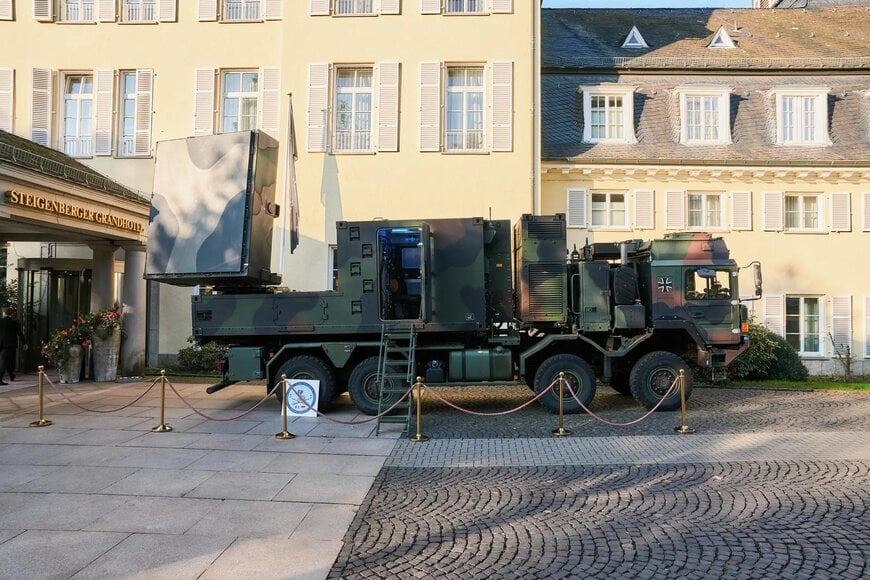
Long-range counter-battery radar remains a core sensor for armies facing artillery, rocket and mortar threats, but systems fielded two decades ago face component obsolescence. HENSOLDT has presented the first fully upgraded German COBRA (Counter Battery Radar) system under the Mid-Life Update (MLU) programme, marking the move from qualification to fleet-wide deployment.
Why Counter-Battery Radars Need Mid-Life Modernisation
A weapon locating radar must detect small, fast projectiles in flight, calculate their trajectories and trace them back to the firing position quickly enough for own forces to return fire. This places sustained demands on signal processing, navigation accuracy and power stability. COBRA systems have been in service with Germany and France since 2005, and the MLU programme was launched and contractually agreed in 2019 by the former ESG, HENSOLDT and Lockheed Martin Corporation to improve system performance and address obsolescence across the fleet.
First Upgraded German System Presented at OCCAR Anniversary
The upgraded system was shown publicly for the first time during the 25th anniversary celebrations of OCCAR (Organisation Conjointe de Coopération en Matière d'Armement), the multinational defence procurement organisation, held on the Petersberg near Bonn. For the presentation, the COBRA radar was installed on the new German carrier vehicle. Germany and France both participate in the programme, and all MLU modernisation work across the participating nations' fleets is scheduled for completion in 2027.
Radar Signal Processing, Navigation and Power Upgrades
The key technical upgrades of the MLU include the integration of a third-generation data system (DGS3), a new inertial navigation unit (NINU), a modernised power supply unit (NPPU) and a new signal processor (NSP). Sophisticated test equipment, including a target generator (RTG) and a new environmental simulator (RES II), has also been integrated. Together, these upgrades are intended to improve system performance and address obsolescence across the fleet.
Carrier Vehicles and Operational Integration
In parallel, Germany and France are introducing modified carrier vehicles (MCVs) under national initiatives, enabling the modernised radars to be deployed on current-generation platforms. A COBRA system has also been supplied to Ukraine as part of Germany's military aid.
Programme Management and Expected Benefits
The programme brings together OCCAR, HENSOLDT as System Design Authority, the industrial partners and the participating states, with the aim of carrying out the upgrade while maintaining the operational readiness of the fleet. According to HENSOLDT, the modernised systems will offer greater reliability, improved maintainability and enhanced operational effectiveness, keeping COBRA in service for detecting and locating enemy artillery, missile and mortar fire.
Additional Context:
This section details technical specifications and competitive benchmarking not included in the original product announcement.
According to OCCAR's technical fact sheet, COBRA uses a fully active phased-array antenna with electronic scanning in azimuth and elevation, built from 2,780 transmit/receive modules containing MMICs. The C-band radar uses waveform and frequency agility, digital pulse compression and Doppler filtering, and provides weapon classification, battery location and impact-point calculation. It scans a 90° sector electronically within an available 270°, detects targets at up to 100 km over an area of about 7,800 km², and can acquire more than 240 weapons in under two minutes. Power comes from a 47 kVA diesel generator. For comparison, Saab specifies its Arthur D weapon locating system with an instrumented range of 100 km and the ability to locate 300 mm multiple-launch rocket systems at that distance.
Edited by Natania Lyngdoh, Induportals editor, with AI assistance.
www.hensoldt.net
