
www.aero-defence.tech
16
'26
Written on Modified on
U.S. Air Force Selects Anduril to Develop Launcher for Counter-Air Missile Program
Anduril is developing a launcher that could integrate missiles from different companies and can operate across dispersed locations for extended periods with minimal personnel support.
www.anduril.com
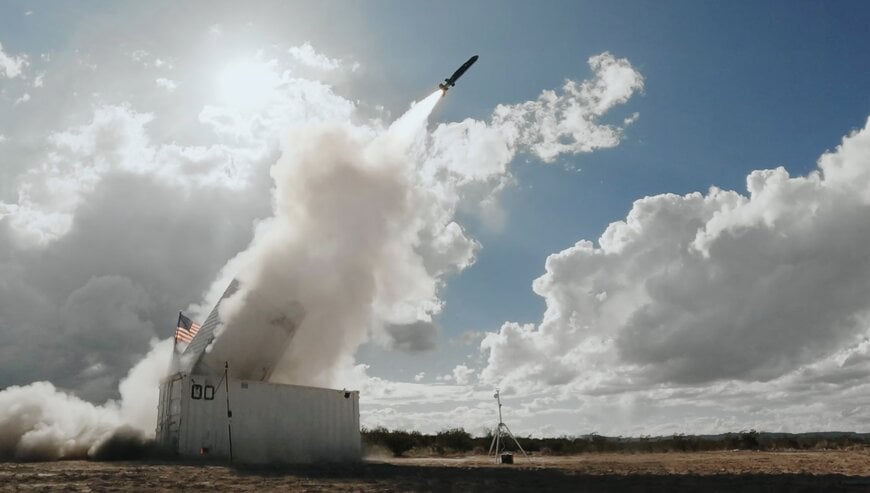
Sustaining air superiority in high-intensity peer conflicts requires vast inventories of affordable interceptors and resilient, mobile launch platforms capable of operating outside vulnerable fixed airbases. Historically, surface-to-air and ground-launched counter-air missile architectures relied on proprietary, vertically integrated launchers tied exclusively to a single prime contractor’s weapon family. These closed designs impose high per-unit procurement costs, require large specialist crews for emplacement and sustainment, and prevent the military from rapidly swapping or mixing munitions from different suppliers as tactical demands or inventory levels shift. Furthermore, fixed airfields and large, high-signature air-defense batteries present prime targets for long-range precision strikes, creating an urgent need for expeditionary, low-footprint launch systems that can operate autonomously across austere locations. Overcoming these operational constraints requires open-architecture, ISO-containerized launchers that decouple weapon-specific launch infrastructure from the missile airframe while embedding manufacturing scalability from initial prototyping.
Open-Architecture Containerized Launcher and Menace-I Integration
To establish a common, vendor-agnostic launch platform for low-cost counter-air munitions, the U.S. Air Force awarded Anduril Industries a prototype contract under the Counter-Air Missile Program (CAMP). Engineered to support dispersed operations over extended durations with minimal on-site personnel, the containerized launcher provides standardized electrical power, edge computing, active thermal management, tactical communications, and fire-control software infrastructure. By centralizing these support subsystems inside the launcher, third-party missile developers can integrate their weapons directly onto the platform via open interfaces rather than engineering bespoke ground-support hardware for each munition variant.
Anduril is deriving the launcher’s core infrastructure from its field-tested Menace-I tactical computing system, which packages ruggedized compute nodes, power distribution, environmental cooling, and resilient communications inside a hardened shelter transportable via military cargo aircraft and standard ground tactical vehicles. Building upon mature hardware and software lowers development risk while minimizing the forward logistical footprint required to deploy, power, and sustain distributed air-defense nodes.
Ten-Month Preliminary Design and Design-for-Manufacturability
Under the prototype agreement, Anduril will adapt its launcher architecture to accommodate munitions developed under CAMP’s Ground Launched Counter Air (GLCA) effort, which focuses on affordable, long-range supersonic interceptors engineered to engage adversarial aircraft from surface positions. During the initial 10-month execution phase, Anduril will collaborate directly with the Air Force program office to complete preliminary design milestones and prepare the launcher for live integration and firing trials with multi-vendor missiles.
To support rapid transition to high-rate manufacturing if selected for follow-on production, Anduril is embedding design-for-manufacturability principles directly into the prototype phase—aligning component selection, modular assembly workflows, supply-chain sourcing, automated testing, and production tooling from the outset to drive down unit costs and accelerate fleet delivery.
Additional Context
This section details technical specifications and competitive benchmarking not included in the original product announcement.
In U.S. Air Force weapon acquisition managed by the Air Force Life Cycle Management Center (AFLCMC) Armament Directorate under 10 U.S.C. 4022 Other Transaction Authority (OTA) agreements, the CAMP-GLCA Enterprise Test Vehicle (ETV) and Common Containerized Launcher (CCL) initiative aligns with the service's Agile Combat Employment (ACE) doctrine and Modular Open Systems Approach (MOSA) mandates. Under ACE operational concepts, small tactical teams disperse combat power across austere, non-traditional airfields and forward operating sites to complicate adversary targeting. Standardizing the launcher within an ISO-compliant containerized footprint allows seamless transport via C-130 Hercules and C-17 Globemaster III airlifters as well as standard Palletized Load System (PLS) heavy trucks, while masking the signature of active air-defense assets among commercial logistics containers. Technically, supporting multi-vendor interceptors requires standardized mechanical hold-down and umbilical disconnect interfaces compliant with Universal Armament Interface (UAI) and M-Series modular weapon standards, alongside high-bandwidth tactical data links (such as Link 16, MADL, or Lattice mesh networking) to receive mid-course target track updates from off-board airborne or ground-based radars before missile launch.
Within the ground-launched counter-air and containerized missile launcher market, Anduril’s CAMP launcher benchmarks directly against established air-defense and containerized weapon platforms from RTX / Raytheon (such as the NASAMS canister launcher, which adapts air-launched AIM-120 AMRAAM and AIM-9X missiles for ground launch), Lockheed Martin (the Mk 70 Mod 1 Payload Delivery System, which packages four Mk 41 Vertical Launching System cells inside a 40-foot ISO container for SM-6 and Patriot PAC-3 MSE interceptors), Kongsberg Defence & Aerospace, and Diehl Defence (IRIS-T SLM containerized launchers). While legacy solutions like the Lockheed Martin Mk 70 containerize naval vertical-launch cells designed for multi-million-dollar fleet interceptors, and NASAMS remains tightly coupled to Raytheon’s fire-distribution center and missile family, the CAMP initiative specifically targets a new class of sub-$500,000 supersonic ground-launched counter-air rounds designed for high-rate mass production (1,000 to 3,500 units annually). By decoupling the launcher’s power, cooling, and command-and-control infrastructure from any single missile manufacturer via its Menace-I and Lattice software stack, Anduril positions its containerized launcher as an open, multi-vendor magazine tailored for affordable mass air defense.
Edited by Romila DSilva, Induportals Editor, with AI assistance.
www.anduril.com
